Today, betting on the mobile market is a business that many are accessing. And it's not surprising, in the last decade, the smartphone has gradually become the most used and demanded device among users.
It's not just a completely useful device, but it's also possible to take it with you to any place comfortably.
Therefore, the development of applications is designed for a very extensive market, where you can benefit according to the needs of consumers.
And understanding the reasons for this excessive growth of mobile applications is key to understanding where we are headed as a society.
Yes, mobile application development is becoming increasingly important and is constantly growing, and in the next few minutes you will understand the reasons.
What is mobile application development?
Mobile application development is the computer process in which a specific function for the user is created, from scratch, an application that adapts to the characteristics of certain devices.
Because yes, depending on the complexity of the application, functions and the requirements necessary to reproduce it, some smartphones will be suitable or not, for installation.
However, in today's app market, the vast majority are adapted for the largest possible number of smart devices. However, this can change over time and with updates.
Delving deeper, the development of applications applies a set of skills and procedures in software writing (programming), and that is applied to wireless and portable devices.
The history of mobile apps
When smartphones began to appear on the market, the development of mobile apps was at such a basic level that every app had to be adapted according to the operating system and processor of each phone.
Today, thinking about that is crazy, but the reason why it was so difficult to develop mobile apps years ago was because there were no dedicated languages or, at best, the existing code was almost non-existent. Therefore, there were no libraries in which to take source codes to use in different projects.
However, with the rise, growth, and demand that new smartphones began to have, the need to create base codes on which to base projects and then reuse them in a way that was compatible with other processors and devices, was becoming increasingly large.
And that's how C#, JavaScript, and Swift are currently used for mobile application development. Programming languages that make the task easier and that work well by taking advantage of the features of a mobile device.
Features of mobile application development
While there are applications dedicated to computers, and in fact, these were the first, with regard to mobile development, it still works through traditional code. However, the difference lies in the fact that these applications seek to take advantage of the features, components, and functions of the smartphone.
For example:
- Camera: applications with special functions, such as filters, QR code reading, translating texts into different languages, searching for objects on Google, etc.
- Microphone: singing applications, audio modification, reading musical notes, the ability to write text using audio, and many more functions.
- Management apps: your personal data, such as email, can be associated with apps to offer a wide range of services: wallets, business management, locations, cloud storage, and much more from a single device.
In short, you can manage and use everything practically from your smartphone. That is the most important feature that must be met.
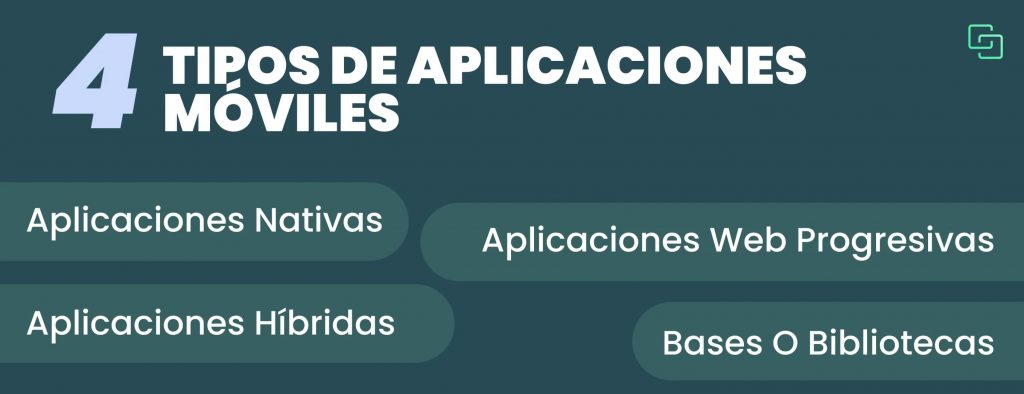
4 Types of Mobile Applications
There are various types of mobile applications for all kinds of needs or functions. It all depends on the developer and their priority, or what advantages they want to provide to the user in question.
1. Native Applications
These are the most expensive type of applications, but also the most stable. They offer a large number of options, features, and customization options depending on whether the device is Android or iOS.
In other words, depending on the type of user and their OS, they can download applications that are specifically for that OS. This offers options that other applications would not have due to their much smaller customization layer.
This is achieved thanks to integrated development environments, also called IDEs, and of course, to the dedicated programming languages depending on whether it is Google Android or Apple iOS.
2. Hybrid Applications
When it comes to profitability, hybrid applications are the norm. This is thanks to the fact that their development cost is much lower, in addition to being ready in less time.
However, they do not allow for a level of customization or utilization of features as complete as native applications. This is something to consider if you like exclusive features and advantages.
On the other hand, they offer a multitude of benefits for users of different operating systems. And that's the important thing, sometimes it's not about exclusivity, but rather truly satisfying the needs for a large majority of users. And the main reason for success, and the basis for most mobile applications.
These applications are carried out through languages such as CSS, JavaScript, and HTML.
3. Progressive Web Applications
Also known as Progressive Web Applications (PWA), these are web applications that behave like mobile applications. And you might ask, in what sense? Well, basically, you can do everything you do in a mobile application.
A clear and simple effect are Facebook and Twitter, which, although they have mobile applications, these offer the same possibilities in their desktop version. This is achieved thanks to Service Workers, which provides the functionality of a common smartphone app.
Web applications that offer special services or functions such as: notifications, offline services, beta versions, are some of the characteristics that identify a Progressive Web Application.
4. Bases or Libraries
In themselves, they do not constitute an application as such. They only represent the source code or base, on which other programmers can use to create, now yes, mobile applications.
The reason these libraries exist is to facilitate the development of applications, allowing you to take a stable base code and start from there to speed up the process. Very useful when you are trying to develop something new without having to write everything from scratch.
Mobile Application Development Process
To be able to create a mobile application, it is fair and necessary to perform a preliminary analysis of conditions, requirements to be met, objectives and needs to be satisfied. Without this, an application will not have a real purpose, and therefore, will not achieve the planned success.
If you want to create an application, consider the following steps for its development:
Step 1: Define the objective
This is key and the most important before development. What is the intention or purpose of the application?, what needs will it satisfy for users? Also, you should study whether there are other applications that are already doing the same as you plan to develop, and if so, what are the strengths and weaknesses of that application.
This, with the intention that you can create a completely new product or service and resolve the flaws of other applications.
At the same time, you should also define your target audience. That is, for whom is the application intended: children, teenagers, adults, elderly?
In short, everything related to the premises of the project, its development and post-development.
Step 2: Determine who will be responsible for its development
Once your mobile application has defined objectives, it is time to determine who will be responsible for its development. You can be yourself, you can hire a freelance developer or an agency dedicated.
Everything depends on what your needs are and who is responsible can meet all the requirements and requests.
Here, it would also be ideal to define if you will need a marketing campaign to promote your application once it is ready. Especially in the beta version, when it is still possible to make the necessary modifications and suggestions provided by users.
Step 3: Make sure to offer a good user experience
Although your product is already defined with objectives to achieve, it is necessary that when the user finally uses the application, the experience is pleasant.
Why?
It's pointless for your application to fulfill its purpose if the process is arduous, complicated, convoluted, and unintuitive. And if it also has errors or bugs resulting from poor programming, that's even worse.
Remember to pay attention to these details! They can make the difference between the project's success or failure.
Step 4: DevOps Development
Now that we've covered everything above, it's time to start developing. Whoever is responsible for the development must have a DevOps mindset.
And what is that? You might be wondering...
DevOps is a work methodology that is increasingly being applied in the general world of software development. This methodology is based on practices that aim to ensure the best quality in the product being developed. For example:
- Use automated processes
There are software and programs that facilitate application development through automated processes. This not only makes the work easier, but also prevents human errors and allows you to finish the work much sooner.
Therefore, whenever possible, use these processes in your development.
Cloud services are very useful due to their large storage capacity, in addition to the ability to store and download very heavy data when needed, even in future projects that may not directly relate to the current one being developed.
A tool that has become increasingly important over time due to the need for storage space. Every day, applications become much heavier due to the increased complexity of their development and the large number of functions they offer.
Whenever possible, working with open-source software or tools will be a great advantage for any development. Not only does it allow for a large number of libraries that can be used to facilitate work, but it also has the support of an experienced community.
Regardless of whether you or a single programmer are responsible for the project, it is necessary to have good communication with both the software you are developing and the materials and/or libraries you are using to develop.
And if it's about a team of workers, communication is vital, both among them and with the client, since they work together, they know how the development process is going, what elements are missing, what might be failing, and so much more.
Communication is vital in every project, and mobile app development is no exception.
It's not necessary for the application to be in its beta version or already "finalized" in order to identify errors or what needs to be improved. Testing should be carried out in every phase of the application's development, from its source code to everything else.
This will allow for much more efficient development, and the resulting product will be of better quality, with good performance and a user interface with a good user experience.
Step 5: BETA Version
Having applied everything above, and with a project in its final phase, it's time to offer a BETA version, so that users can use it and make suggestions and recommendations.
This is with the intention of finalizing the details and ensuring that the final product meets expectations and even more.
Once the test is complete and all the details have been fixed, the application will be ready for its official launch and everyone's enjoyment.
The development of mobile applications is a very interesting and highly demanded field in the current market. Therefore, it is a very attractive job for many technology enthusiasts. And over time, the development will continue to evolve, so it is ideal to start now if this is your goal.
Mobile applications are very useful, practical, and are constantly being updated and innovated. The goal is to meet the needs of users, taking advantage of the features of the specific mobile device.
How far will mobile application development go? Until our imagination and needs dictate it.
Are you a mobile application developer? What is your favorite part of this job or what motivated you to become one?