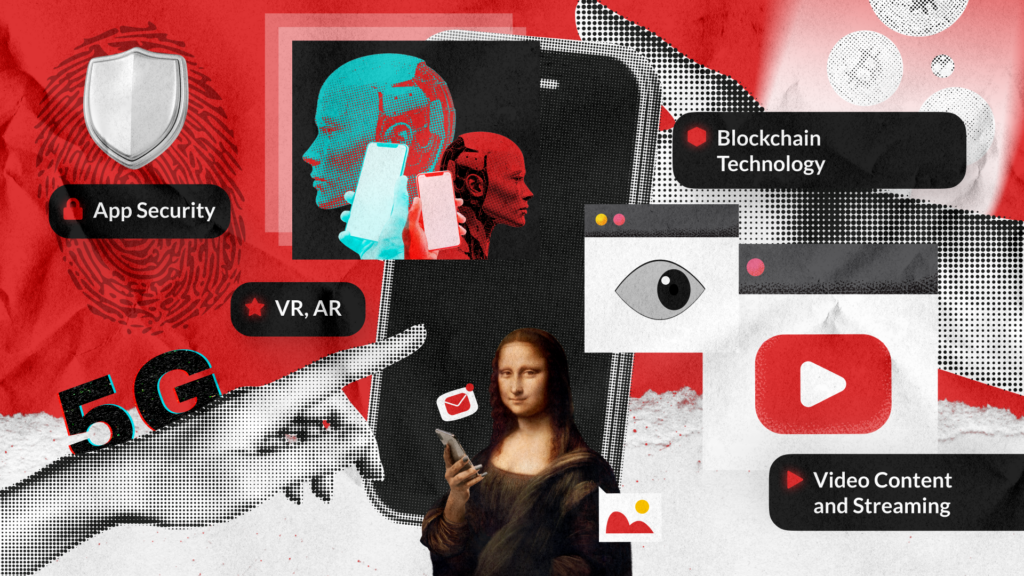
The trends in mobile app development dominate the agenda of numerous technology conferences, and for good reason. Mobile app downloads stalled after the surge caused by the pandemic, meaning that founders of technology companies, product managers, and technology directors must innovate quickly to grow their user bases and ensure that their apps remain relevant.
As a mobile app development company, Redwerk's team continuously monitors the latest trends. This allows us to provide real value to our clients while supporting them from concept creation to launch. We have analyzed what the leading global players are doing and combined it with the needs of our clients to create a list of the mobile app trends that will dominate 2025 and the years to come.
1. AI and Machine Learning
Generative AI has experienced rapid success and, undoubtedly, is here to stay. Apps that want to remain on the radar of their users must continuously think about how to best meet user demands. AI-powered or ML features are some of the most critical expectations. Here is a selection of use cases for AI in mobile apps:
- Personalized content and product recommendations
- Real-time language translation
- Assistance with writing and text correction
- Applying filters and effects to photos and videos
- Tracking health metrics and providing personalized information about one's own well-being
- AI-powered tutoring and language learning
- 24/7 customer support with conversational chatbots
- Fraud transaction identification
With the launch of Apple Intelligence, the Cupertino-based tech giant has not only given more power to users, but also to developers. The new APIs and frameworks introduced in Apple's SDK (software development kit) will allow iOS developers to integrate a range of AI-based features into their applications, from image generation capabilities to writing tools and an improved Siri. Of course, adding AI can increase the total cost of developing iOS applications, but it is often a necessary investment to ensure long-term success.
Get instant academic help with Answer.AI
Android developers will also benefit from this, as they will be able to introduce AI features into their applications. There are several ways to apply this technique, and we can use the example of Google. Google already offers two main options: its Gemini API through Vertex AI, and its Gemini Nano for on-device AI.
2. Social Network Features in Financial Applications
One of the most interesting trends in the development of mobile applications is the convergence of social and financial features. We are witnessing a shift towards applications that do both: managing money and fostering social connections. Platforms like Venmo are leading the way with features such as group money pooling, which makes it easy to split bills, plan trips, and manage shared expenses with friends and family.
What really sets Venmo apart is its transaction feed. Venmo allows users to share the details of payments, add captions or emojis, and interact with the transactions of others, transforming financial exchanges into social conversations.
These social features create an opportunity for viral marketing: users are more likely to recommend an application that allows them to share experiences, such as pooling money for a trip or a wedding, and engage with their network.
3. Mobile and Social Commerce
Around 76% of American adults shop online using smartphones. As more and more consumers turn to their smartphones to shop, businesses must optimize their mobile apps for commerce. This means ensuring that pages load quickly, even when they contain many images.
Navigation should also be easy to use, and the purchase process should have the fewest possible steps. A seamless experience across devices will allow customers to start a purchase on their phone and finish it on a laptop, without having to re-enter data.
This trend of mobile applications is intertwined with social commerce. Social commerce is the practice of selling products and services directly on social media platforms, allowing customers to purchase without leaving the app. TikTok, Facebook, Instagram, and Snapchat are no longer just social media platforms; they are social commerce apps. They offer a native payment process that allows users to complete purchases without leaving the app, eliminating friction and encouraging impulse buying.
4. Emphasis on video and streaming content
There has been a significant shift towards integrating video and live streaming content within apps to improve user engagement. It's no surprise that two video streaming apps, PBS Kids Video and Peacock TV, are already among the best Google apps of 2024.
Statista discovered that a large number of young adults in the U.S. frequently watch videos on their phones. Specifically, 79% of people aged 18 to 34 stated that they use their smartphones to watch online videos every week.
Thanks to its multisensory appeal, video content is more engaging and keeps the user's attention for longer than text or images, which increases usage and app loyalty. Advances in mobile hardware, as well as faster internet speeds, make video creation and transmission more accessible. Apps with robust video features are more attractive to both users and creators.
Video resume with teleprompter in Recruit Media
Video features can be one of the most exclusive selling points of your product. For example, we helped one of our clients create an innovative recruitment app with a video resume feature, as well as a teleprompter, which differentiated them from their competitors.
5. Increased security and parental control
This particular trend in mobile applications is driven by a combination of factors, such as the growing concern of parents about online risks, increasing regulatory pressures, and the constant desire to earn user trust.
A notable example of this trend is the introduction by Snapchat of location alerts for parents. This feature allows parents to receive notifications when their teenage children arrive or leave specific locations, providing peace of mind and enabling proactive communication. Other apps such as YouTube Kids and TikTok have implemented age-appropriate content filters, screen time limits, and parental supervision tools to protect young users.
6. Multi-platform development tools
Frameworks such as Flutter, React Native, and Xamarin allow developers to create applications that can run seamlessly on multiple platforms (iOS, Android, and sometimes web) using a single codebase. This approach offers numerous advantages, such as significant cost savings, accelerated time to market, and reduced maintenance costs.
Furthermore, cross-platform development allows companies to reach a wider audience with a consistent user experience across different devices. For new companies, choosing the right cross-platform framework can be a strategic decision that allows them to scale efficiently and quickly respond to market demands.
Notable applications such as eBay, Alibaba, Square, and WeChat were created with Flutter. At Redwerk, we also favor Flutter over other cross-platform tools because it uses the Dart programming language, which ensures optimized development and performance.
7. Augmented Reality and Virtual Reality
AR/VR will continue to be on the list of industry trends for mobile applications. The number of mobile AR users worldwide is constantly growing, although slowly. It is expected that mobile AR will reach 1.190 million users in 2028. IKEA Place, Snapchat, TikTok, and Pokémon GO are famous for their fun AR features.
As AR and VR technologies continue to advance, we will also see more innovative AR companies. Here are some AR features that you can consider and that could perfectly fit into your mobile application:
- Virtual testing
- Product visualization in real environments
- Virtual tours of properties
- Interactive learning with 3D models, animations, and simulations
- Immersive games
- How to get there on foot or by car
- Navigation within large buildings such as airports, shopping malls, or hospitals
- Maintenance and repair guides
- Overlaying information on landmarks, artwork, or exhibitions
- Creating attractive ads and social media experiences
Preview tattoo designs with AR in InkHunter
8. Integration of wearable devices
The growing popularity of smart glasses, smartwatches, fitness trackers, and other wearable devices has opened up a world of new opportunities for mobile app developers. By integrating with wearable devices, apps can offer a more personalized user experience. This trend is particularly relevant for the healthcare, fitness, and retail sectors. For example, the recent collaboration between Meta and Ray-Ban has been the subject of much attention.
Let's now move on to specific sectors. Healthcare applications can track vital signs, monitor medication adherence, and send timely alerts to users' wrists. Fitness applications can provide real-time metrics, personalized training plans, and motivational reminders. Through wearable devices, e-commerce apps can enable contactless payments, product information, and loyalty program rewards.
9. App Security: Privacy and Data Protection
The emphasis on app security is undoubtedly one of the most important trends in mobile app development. Protecting users' confidential data and preventing data breaches are crucial efforts. A secure app can improve its reputation and attract more users. Increased security will also help you comply with regulations such as GDPR and CCPA, avoiding potential legal issues. Furthermore, unique security features can give your app a competitive advantage in a saturated market.
Here are some privacy and data protection features to consider when designing your app:
- Encryption of data in transit and at rest: Uses protocols such as TLS/SSL for data transmission and AES for its storage
- Biometric authentication: Uses fingerprints, facial recognition, or iris scanners for secure login
- Multi-factor authentication: Requires additional verification steps, such as one-time passwords (OTP) or biometric data
- Lock mode: Limits certain application features and system interactions
- Fraud detection algorithms: Monitors transactions for unusual activity using AI and ML
- Device linking: Associates user accounts with specific devices to prevent unauthorized access
10. Blockchain for mobile applications
Blockchain has some key advantages, such as security, transparency, and decentralization. All of these help to solve critical problems related to data integrity and trust. By incorporating blockchain, mobile applications can offer secure transactions, decentralized data storage, and smart contracts that automate processes without intermediaries.
Startups can gain a competitive advantage by integrating blockchain into their mobile applications. Cryptocurrency wallets, DeFi platforms, and supply chain tracking applications are excellent examples of blockchain-powered mobile applications.
Redwerk has practical experience in blockchain development. We built Tingl, a web3 messenger for private chat. It is based on blockchain technology for end-to-end encryption, data integrity, and anonymous communication. By combining a custom transport protocol with a Proof-of-Stake consensus mechanism, we ensure the security and privacy of user messages.
11. Predictive analytics
Predictive analytics allows developers to anticipate user needs and behaviors. By analyzing large amounts of data with advanced algorithms and ML, applications can identify patterns and trends and adapt the user experience to individual users. Here are some examples of leading industry applications that use predictive analytics.
Duolingo uses predictive analytics to recommend the most relevant language lessons based on the user's progress and areas of difficulty. Waze leverages this technology to predict traffic conditions and suggest the fastest routes. Uber uses it to balance supply and demand, anticipating areas of high demand and adjusting prices to attract more drivers. Spotify recommends songs and artists based on the user's listening history and introduces new music that they might like.
Numerous companies continue to invest in predictive analytics because it improves user satisfaction, drives retention, and fosters brand loyalty. Undoubtedly, this trend of mobile applications will endure.
12. 5G Technology
The deployment of 5G technology brought faster speeds, improved connectivity, and a multitude of new possibilities for both developers and users. 5G is becoming widespread, and its influence on the development of mobile applications is impossible to ignore. Almost 40% of wireless devices in the US are now connected to 5G, which drives the need to optimize applications.
Now is the time to think about how 5G can enable new features in your application. For example, you could incorporate elements of AR/VR, real-time data analysis, or high-definition video content. Prioritize the features that will add value and align with your business goals.
The best way to prepare your application for the 5G era is to review the architecture and codebase of your application, which will eliminate bottlenecks that could hinder performance. Remember that it is also important to improve your security measures.
13. On-demand Applications
The creation of on-demand applications is not a new trend in mobile applications. However, this business model perfectly fits the preferences of modern consumers for convenience and immediacy. Advances in mobile technology, GPS, and payment systems have made it possible to develop reliable on-demand platforms.
On-demand applications are often associated with food delivery apps such as DoorDash, Grubhub, or Lieferando, and car-sharing apps such as Uber, Lyft, or Bolt. However, the on-demand model is expanding to new sectors, including:
- Education: Private tutoring and customized educational content
- Logistics: Transportation and delivery services for businesses
- Professional Services: Legal advice, financial consultations, and second medical opinions
- Sustainability: Electric vehicle charging and eco-friendly home services
- Tourism: Customized booking of activities and local excursions
At Redwerk, we have years of experience in creating customized applications. We helped Gooroo develop a robust mobile app for tutors, which simplifies the provision and management of online tutoring services.
14. Super Apps
Super apps consolidate multiple services into a single platform, eliminating the need for multiple apps. By grouping services, super apps increase user retention and discourage competition.
WeChat, a popular messaging app in China, has evolved into a multifunctional platform that encompasses messaging, social media, mobile payments, transportation services, and even games. Alipay, another Chinese technology giant, offers a wide range of financial services, such as online payments, asset management, and insurance. LINE is a Japanese messaging app that offers games, digital payments (LINE Pay), shopping, taxi services, job offers, and even medical consultations.
While it is true that super apps are more popular in Asia, there is a growing interest in other regions of the world. Revolut, for example, a European fintech app, offers banking services, cryptocurrency exchange, stock trading, and budgeting tools, with the goal of becoming a super financial app.
15. Voice search and voice user interfaces
Voice assistants such as Siri, Alexa, and Google Assistant have popularized voice search and voice user interfaces (VUI). It is predicted that 64% of the US Gen-Z population will use voice assistants monthly by 2027, a significant increase from 51% in 2023.
VUI also offer hands-free interactions, making apps more accessible and convenient. The integration of voice features can improve the user experience by allowing commands in natural language and faster access to app functionalities.
As natural language processing and speech recognition technologies continue to improve, we will see more sophisticated and personalized voice assistants. Here are some practical examples of integrating voice features into your mobile app:
- Navigation without contact via voice commands
- Voice search
- Setting reminders
- Asking questions or retrieving information from applications
- Composing messages, emails, or notes via voice
- Helping users with visual or motor impairments to perform everyday tasks
- Using voice recognition to provide information about pronunciation accuracy
- Recording meals and workouts via voice
- Managing multimedia playback functions such as play, pause, skip, and volume control via voice commands
In summary
Trends in mobile application development are known for their long lifespan. While it is undeniable that AI has become the latest trend in mobile applications, it is not that it has not been used before. What is happening is that AI has become widespread. All the technologies and business models that we have listed here have already been adopted by some market players, and will lead to new, even more innovative startups.
If you have an idea of how to keep your mobile application trending or are just exploring the possibilities of creating the next big innovation, don't hesitate to contact Redwerk for a professional consultation. Since 2005, we have successfully completed over 250 projects for companies in North America and Europe. We can help you put your vision into practice in a timely and stress-free manner, so you can always stay ahead of the curve.